Save the date

NAT’26

22.-24.04.2026

Welcome to NAT’26 – Europe’s Neuroadaptive AI Conference

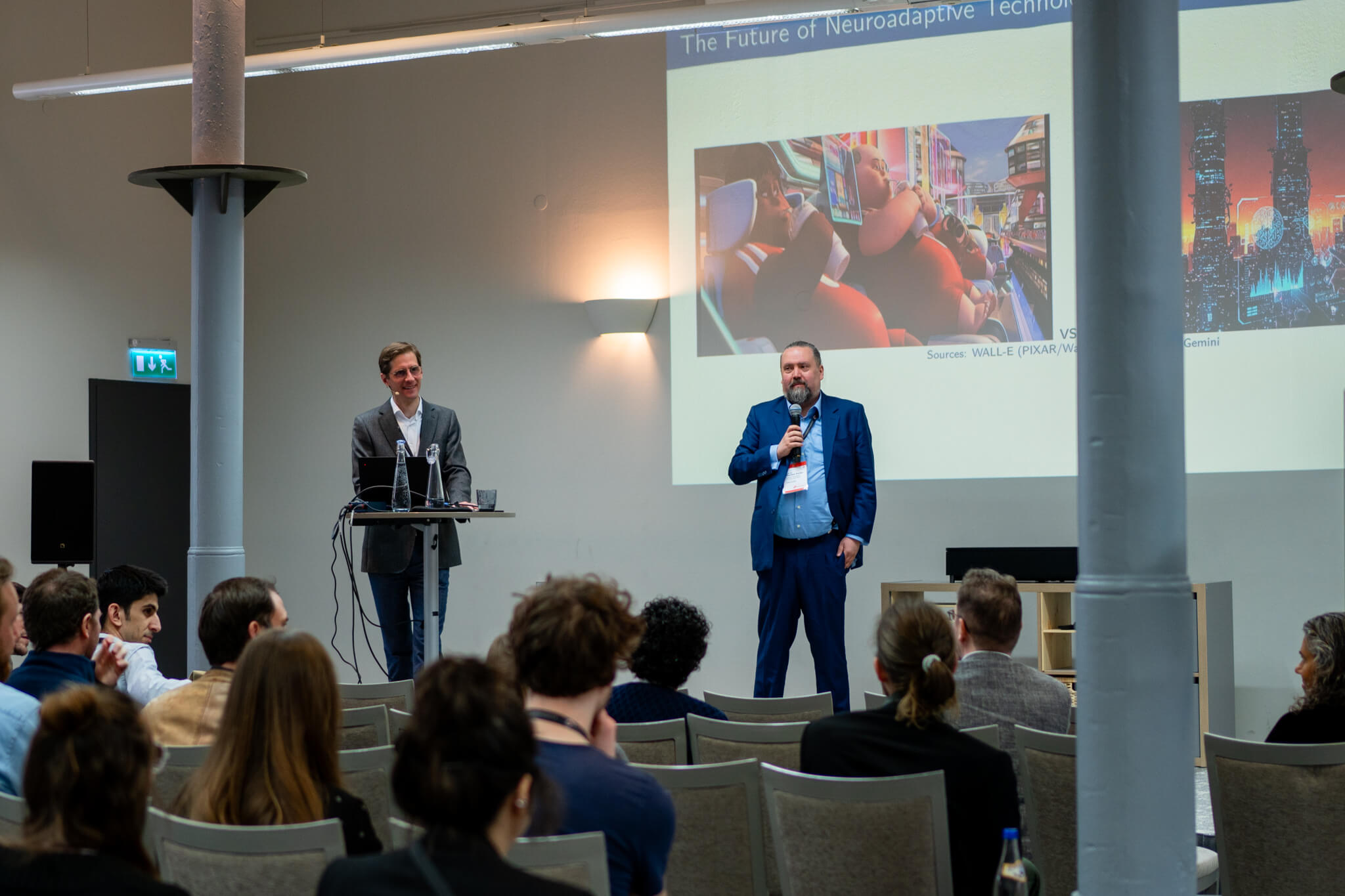
NAT’26 is the first European event dedicated to Neuroadaptive AI – where brain data meets adaptive technology. This conference brings together researchers, innovators, and critical thinkers to explore how these systems can benefit individuals and society.

Join us for three days of cutting-edge science and breakthrough tech development and shape the future of Neuroadaptive AI both in academia and applications! 

Day 1+2 - scientific conference

Brain Meets AI - Deep Science, Shared Curiosity

The first two days of NAT’26 are where BCI, neuroscience, and AI communities come together around a shared topic: neuroadaptive technology. Over two days of keynotes, peer-reviewed talks, and posters, experts from academia and industry engage in in-depth discussions on brain and physiological signals, intelligent adaptive systems, and real-world experiments — from closed-loop paradigms and user modelling to learning algorithms and interactive applications. These days are designed for scientists and industry experts who want to dive deep into data, models, while connecting with colleagues from other domains to exchange perspectives and co-create new solutions.

Day 3 - open conference

From Lab to Market - Translating Science into Impact

The third day is dedicated to translation of NAT and building industries on it – where breakthrough research meets real-world application. This day brings together startups, industry leaders, applied researchers, and investors who are shaping the future of AI-driven neuroadaptive technologies in health, mobility, education, gaming, security, human-computer interaction, and beyond. Explore how cutting-edge science becomes scalable solutions, discover emerging business models, and gain insights into regulatory, funding, and go-to-market strategies.

Last but not least, the conference will be open to all non-professionals who are curious about the topic on the final day. 

Sponsored by

Latest News

Poster and talk guidelines for your NAT’26 presentation

Talk guidelines Talks are 15 minutes plus 5 minutes for questions. Please.

NAT’26 – conference program

Day 1 – April 22 «Science» ↓ Download detailed program and abstracts.

Submission Deadline Extended to February 28

We are pleased to announce that the abstract submission deadline for NAT’26.

Conference program

Highlights day 1+2
Research insights into neuroadaptive technologies and AI

Dr. Laurens Krol
“Project NAFAS: The Path and the Progress towards Neuroadaptive Artificial Intelligence

Project NAFAS (Neuroadaptivity for Autonomous Systems) is a EUR 30M research project funded by the German federal agency Agentur für Innovation in der Cybersicherheit – “Innovation for Cybersecurity”. Its goal is to research and develop both technological foundations and application demonstrators for various safe and secure forms of neuroadaptive technology, including specifically neuroadaptive artificial intelligence. Having started in late 2023, the four-year project has now completed its first phase, which focused primarily on the foundational necessities: i.a., data acquisition, plug-and-play decoders, and mobile hardware. This keynote presents the current state of the project illustrated by select achievements, and the implications for the wider field.

Dr. Laurens R. Krol is co-founder and Research Director of Zander Labs, a German-Dutch deep-tech startup pioneering passive brain-computer interfaces and neuroadaptive technology. With his doctorate from Technische Universität Berlin, Dr. Krol helped define the field of neuroadaptive technology through foundational research on implicit interaction and cognitive probing. At Zander Labs, he leads the exploration of novel ways to harness neural correlates of human intelligence, driving toward safe, human-centric neuroadaptive synergy that transforms how humans and technology interact.

Dr. Mike Ambinder
“One Possible Future: How Physiologically Adaptive Video Games Create New Kinds of Play and Foster New Kinds of Industry

For those curious about one instantiation of adaptive technology that promises to lead to many others, this talk will cover how adaptive video games represent an opportunity to push forward the development of responsive interfaces in a wide variety of other domains. Traditional gameplay converts rudimentary estimations of cognitive intention into audio and visual (and haptic) responses that aim to drive challenge, engagement, and entertainment. Incorporating physiological signal measurement as a direct input to gameplay systems produces qualitatively new kinds of play, broadens the stimulus-response space well beyond the current modalities, and offers a novel form of data collection and experimentation that informs adaptive technology and experience development both within the world of video games and certainly well beyond it.

Mike Ambinder has a BA in Computer Science and Psychology from Yale University and a PhD in Psychology from the University of Illinois. He spent 15 years leading research efforts at Valve (video game developer responsible for Steam, Half-Life, Portal, Counter-Strike, Dota, Team Fortress 2, HTC Vive, Valve Index) producing pioneering work on the application of knowledge and methodologies from psychology to game design, the formation and implementation of in-game economies, the use of statistics and machine learning (and now AI) to operationalize and evaluate game design hypotheses, non-invasive Brain-Computer Interface experiments to facilitate new forms of adaptive gameplay, and a few other things. In addition to current consulting and advisory work, he acts as the Chief Research Officer and Chief Technology Officer for a startup attempting to understand the mechanics of skill development in interactive technology.

Dr. Philipp Wicke
“From Probing Concepts in Language Models to Reading Them in the Brain”

How do we compare language model conceptualisation capabilities with those arising from embodied human cognition and is this even a fair comparison to begin with? Published computational probing studies show where LLMs systematically diverge from human conceptualization: in figurative language grounded in bodily experience, in spatial schema intuitions, and across linguistic-cultural boundaries. These divergence points define a set of open questions that neuroadaptive methods are uniquely positioned to answer. If we know where models fail at human-like meaning, we can design EEG paradigms that target those exact domains, revealing what the human brain computes that statistical models do not.

Philipp Wicke is a Cognitive Scientist and AI researcher specializing in Natural Language Processing and neuroadaptive systems. He studied Cognitive Science at the University of Osnabrück and conducted research in neuroinformatics and computational storytelling at institutions including NTU Singapore and University College Dublin. He was an assistant professor at LMU Munich and currently teaches Artificial Intelligence at BTU Cottbus. Philipp Wicke is the Lead AI Scientist at AURYAL, a European neurotechnology startup supported by SPRIND, where he advances adaptive AI systems at the intersection of language, cognition, and brain-computer interfaces.

Highlights day 3
Translation to industry and society

Prof. Thorsten Zander
TU Brandenburg & Founder
Keynote

MdB Thomas Jarzombek
Parliamentary State Secretary
Impulse, Q&A

Prof. Sascha Friesike
Director Weizenbaum Institute
Q&A

Dr. Tina Klüwer
AI founder
Impulse, Q&A

Dr. Max Neufeind
German Chancellery
Dialogue

Dr. Jennifer Haase
Weizenbaum Institute
Dialogue

Venue

NAT’26 will be hosted by the prestigious Weizenbaum Institute in Berlin, a leading institution in AI and digital transformation research.

The institute is located in the central district of Berlin, in close proximity to notable landmarks such as the Kaiser Wilhelm Memorial Church, the Technical University of Berlin, and the Berlin Zoo. It is within a short walking distance of the Zoologischer Garten train station and is surrounded by a range of high-quality hotels.

Topics

Broad Areas

Neuroadaptive Technology

Artificial Intelligence

Applications

Specific Topics

Passive BCIs
Physiological computing
Affective computing
Neurofeedback
Neuroethics
Neurogaming
User modeling

Machine learning
Reinforcement learning
Deep learning
Autonomous systems
Wearable sensors
Autonomous driving

Virtual reality
Robotics
Legal consideration
Societal impact
Industrial deployment
Marketing and communication

Upcoming deadlines

Paper and abstract

  • Submission system opens: December 1, 2025
  • Submission deadline: February 6, 2026
    DEADLINE EXTENDED: February 28, 2026
  •  
  • Decision notifications: March 12, 2026
  • Camera-ready submission deadline: March 27, 2026

Go to submission

Registration

  • Early-bird registration opens: December 12, 2025
  • Early-bird registration closes: February 6, 2026
  • Regular registration closes: March 20, 2026
  • Late/on-site registration: March 21-April 24, 2026

Go to registration

Submission

–> Talk and poster guidelines

We welcome novel research results, but also explicitly invite already-published work to provide an overview of relevant research in the different domains to a new audience. We also highly encourage PhD students and early-career researchers to submit research plans to get constructive feedback from the community.

There are two types of submissions to the NAT26 conference:

  • Short papers have a maximum length of 2 pages, including at most 1 figure.
  • Full papers have a maximum length of 6 pages, including at most 3 figures. References do not count towards the maximum page length.

In your submission, please indicate whether you would like to present your work as a poster or as a talk. Presentation of the work is required by at least one of the authors in order to be eligible for the final conference proceedings. Further information is provided in the submission portal. 

Registration

All inclusive (conference, lunch included) + 50,- for the social evening

Courtesy of our sponsors, we can offer free tickets to students (bachelor’s, master’s, PhD). Read more

Early Bird

until February 6

Standard

EUR 500

Student / PhD

EUR 300

Industry

EUR 700

Regular

until March 20

Standard

EUR 600

Student / PhD

EUR 400

Industry

EUR 800

Late

from March 21

Standard

EUR 700

Student / PhD

EUR 450

Industry

EUR 900

Special

Public ticket – FREE 
for interested non-professional attendees, valid on April 24 only. Fully booked, no more tickets available

Conference Committee

Conference Chair
Prof. Dr. Thorsten Zander

Chair “Translation”
Dr. Thomas Ramge

Chair “Science”
Dr. Marius Klug

Organizing Committee
Lucija Mihić Zidar

Organizing Committee
Lea Rabe

Organizing Committee
Dr. Felix Schröder

Stay up-to-date

Join our e-mail list and receive notifications about NAT’26.

NAT'26 Navigation

Photos by Zander Labs

This conference is organized in cooperation with

The Microsoft CMT service was used for managing the peer-reviewing process for this conference. This service was provided for free by Microsoft and they bore all expenses, including costs for Azure cloud services as well as for software development and support.